

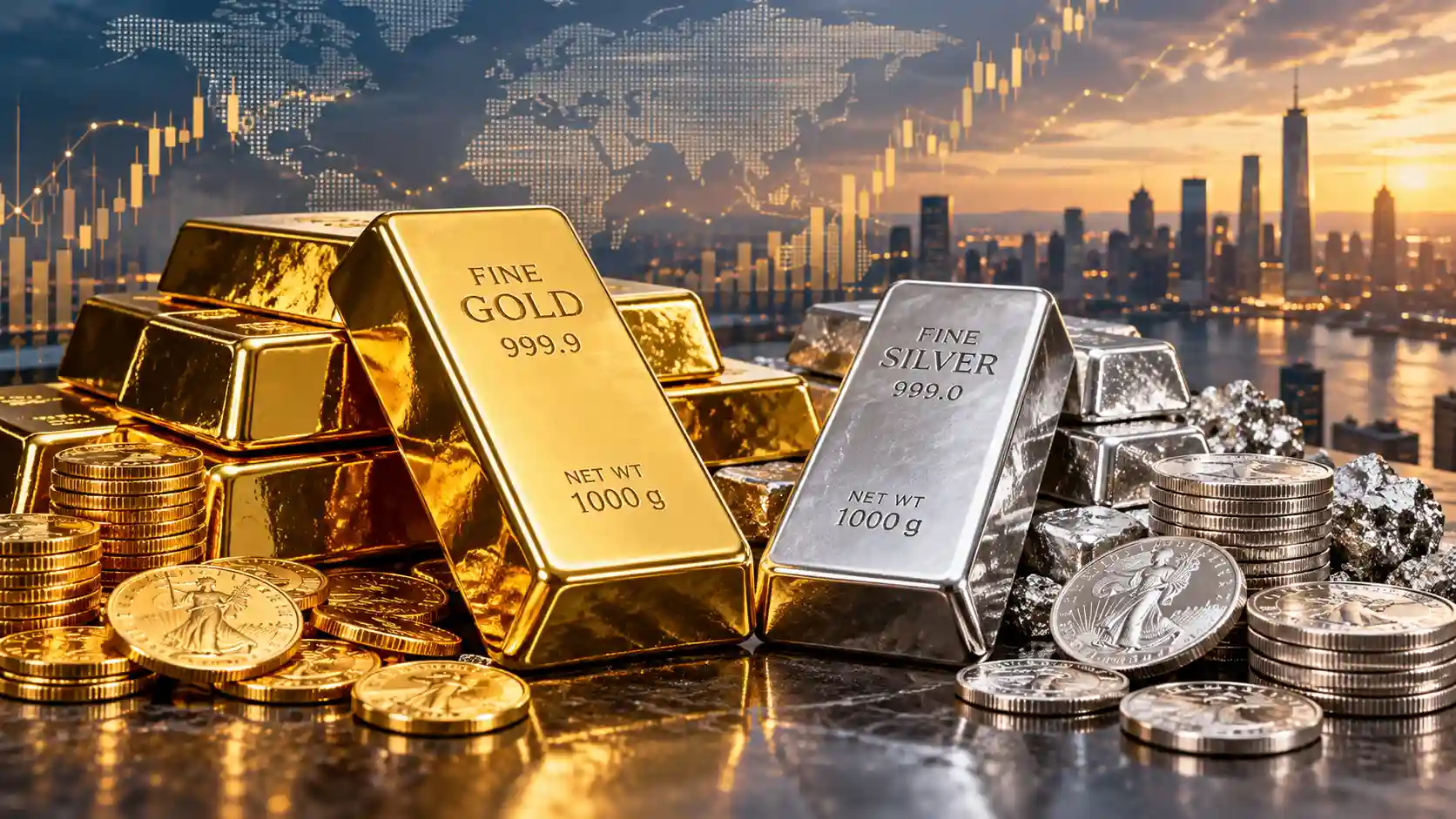
Gold & Silver Market Tracker
Track the latest available market data for gold and silver in USD per troy ounce.
Note: Market data is provided through TradingView. Data availability and timing may vary by instrument and data source.
The precious metals market is often viewed through a simple question: Are gold and silver going up or down? But the real story is much bigger than a number moving on a price ticker.
Gold and silver are influenced by a combination of interest rates, central bank policies, currency movements, inflation expectations, geopolitical developments, investor sentiment and physical demand. That is why prices can sometimes move sharply even when there is no obvious change in the metal itself.
For global investors and everyday market watchers, the real challenge is not simply looking at a chart. It is understanding why the market is moving, what is driving the move and whether the underlying conditions are temporary or part of a broader trend.
Why Gold and Silver Can Move So Quickly
Precious metals do not trade in isolation. Their performance is closely connected with the wider global financial system.
When expectations around interest rates change, investors reassess the opportunity cost of holding assets such as gold. At the same time, movements in the U.S. dollar can influence how dollar-denominated commodities are valued for buyers around the world.
Geopolitical uncertainty can add another layer to the market. During periods of heightened uncertainty, some investors turn their attention toward gold because of its long-standing role as a store of value and portfolio diversification asset.
Silver has a somewhat different personality. It is both a precious metal and an important industrial commodity. Its market can therefore be influenced not only by investment sentiment but also by manufacturing, electronics, renewable-energy applications and broader industrial demand.
The Retail Investor Mindset: Fear, FOMO and Real-Life Market Experience
This is where the market becomes much more interesting — because the precious metals market is not only about charts and numbers. It is also about human emotions.
Whenever gold or silver moves sharply higher, you will usually see two different types of retail investors.
One group becomes nervous and starts thinking: “The price has already gone too high. What if it falls?” They may sell simply because they are afraid of losing their recent gains.
The second group reacts in exactly the opposite way. They see the rising price, hear people discussing the market and start thinking: “If I do not buy now, I may miss the next move.”
That is where FOMO — the fear of missing out — can take over. Instead of following a previously considered plan, the investor suddenly starts chasing the market.
And this is one of the most important lessons for a new investor: the market can test your emotions just as much as your financial knowledge.
A small correction can feel like a major problem when someone has entered the market near a recent high. But market pullbacks are a normal feature of financial markets. They do not automatically mean that the long-term story has changed.
The better question is not simply, “Why did the price fall today?” but rather, “What actually changed in the underlying market conditions?”
Short-Term Price Moves vs. the Bigger Picture
Daily price movements can be influenced by profit-taking, changes in interest-rate expectations, currency movements, economic data and sudden geopolitical headlines.
This is why reacting emotionally to every movement can make investing unnecessarily difficult.
A short-term trader and a long-term investor may look at exactly the same chart but see two completely different things. A trader may focus on momentum and technical levels, while a long-term investor may be more interested in monetary policy, inflation expectations, global demand, portfolio allocation and the broader economic cycle.
There is no single approach that works for everyone. The important part is understanding which approach matches your own financial situation, risk tolerance and investment horizon.
Key Global Drivers Behind Gold and Silver
Anyone following precious metals should keep an eye on several major forces rather than relying only on the latest price movement.
1. Central Bank and Interest-Rate Policies
Central bank decisions can have a major influence on precious metals. Changes in interest-rate expectations can affect bond yields, currencies and investor demand for assets such as gold.
For this reason, monetary-policy decisions and central-bank guidance remain an important part of the global precious-metals story.
2. The Strength of the U.S. Dollar
Gold and silver are widely quoted in U.S. dollars, so movements in the dollar can influence global precious-metal pricing.
However, the relationship should not be treated as a simple rule that works perfectly every day. Markets are driven by several factors at the same time.
3. Geopolitical Uncertainty
Global conflicts, political uncertainty and economic instability can influence investor sentiment and market expectations.
Gold in particular can attract attention during uncertain periods because investors have historically viewed it as a defensive asset. But market reactions are not guaranteed to move in one direction every time.
4. Industrial Demand for Silver
Silver deserves separate attention because of its industrial role.
Demand from manufacturing, electronics and renewable-energy-related applications can influence the long-term outlook for silver. This makes silver different from gold, where investment and monetary characteristics play a much larger role.

Why a Market Correction Is Not Always a Warning Sign
One of the most common mistakes among new investors is assuming that every decline means something has fundamentally gone wrong.
Markets do not move in a straight line. Even during a strong long-term trend, periods of consolidation and correction can occur.
Profit-taking is one possible reason. Changes in market expectations are another. Sometimes investors simply rebalance their portfolios after a strong period of gains.
Therefore, a short-term decline should be viewed in context rather than automatically interpreted as either a buying opportunity or a reason to panic.
The important lesson is simple: a price move tells you what happened, but understanding the drivers can help explain why it happened.
How Retail Investors Can Look at Gold and Silver More Rationally
Understanding the market is one thing. Managing your own emotions while participating in it is another.
For a retail investor, the biggest advantage may not always be predicting the next move correctly. Sometimes it is simply having a plan and avoiding emotional decisions when the market becomes noisy.
Wedding and Festival Demand: The Difference Between Global Prices and Local Buying
There is another side of the gold market that is easy to overlook when looking only at global financial charts: physical demand.
Around the world, gold has cultural importance that goes far beyond investment. Weddings, festivals, family traditions and jewellery purchases can create seasonal demand in different markets.
This is particularly important in countries where gold jewellery is deeply connected with social and cultural traditions. A family preparing for a wedding may not think about gold in the same way as a professional market trader.
The global spot price may be moving in one direction, while a local buyer is thinking about an upcoming wedding, festival or family event.
That is why global spot prices and physical-market behaviour should not always be viewed as exactly the same thing.
Local premiums, taxes, currency movements, jewellery-making costs and seasonal demand can also influence what consumers actually pay.
In simple words, the global market tells one story, while the local physical market can sometimes tell another.

DCA and SIP Thinking: A More Disciplined Approach
What should a retail investor do when gold or silver is trading near elevated levels or moving through a consolidation phase?
One possible approach is to avoid putting all available capital into the market at one time.
Instead, some investors prefer a Systematic Investment Plan (SIP)-style approach or Dollar-Cost Averaging (DCA), where money is deployed gradually according to a predefined plan.
The idea is simple: do not try to perfectly predict the top or bottom.
For example, rather than making one large purchase simply because the market is rising quickly, an investor may divide the intended allocation into smaller portions and invest over a period of time.
This approach can reduce the emotional pressure of trying to identify the perfect entry point. However, DCA does not guarantee profits and does not eliminate investment risk.
The right strategy depends on an individual's goals, financial position, investment horizon and risk tolerance.
What Investors Should Watch Instead of Only Watching the Price
A market tracker is useful, but a price number alone does not explain the whole market.
If you are following gold and silver regularly, it can be useful to watch these broader indicators and developments:
- Central-bank monetary-policy decisions and guidance
- U.S. dollar movements and broader currency conditions
- Inflation and economic-growth expectations
- Bond yields and changes in interest-rate expectations
- Geopolitical developments that may influence investor sentiment
- Central-bank gold demand and official reserve trends
- Industrial demand for silver
- Physical jewellery and investment demand in major markets
Gold vs. Silver: Similar Market, Different Personality
Gold and silver are often discussed together, but they do not behave exactly the same way.
Gold is widely associated with wealth preservation, central-bank reserves, investment demand and its traditional role as a defensive asset.
Silver has both monetary and industrial characteristics. Because of its industrial applications, changes in manufacturing activity and technology-related demand can become important parts of its market story.
This difference is one reason investors should not automatically assume that a movement in gold will produce an identical movement in silver.
The Investor's Perspective
At the end of the day, markets will continue to move. Some days will bring strong gains, some days will bring sharp declines, and other periods may simply move sideways.
The difficult part is not watching the chart. The difficult part is staying disciplined when the chart starts moving quickly.
Fear can make an investor sell too early. FOMO can make an investor buy too late.
That is why understanding your own investment plan can be just as important as understanding the market itself.
Instead of asking only, “Where will gold or silver go next?” it can be more useful to ask:
- What is my investment time horizon?
- How much volatility can I realistically handle?
- Am I buying because of a plan or because everyone is talking about the market?
- Am I reacting to a short-term move or a genuine change in fundamentals?
- Would gradual allocation make more sense for my situation?
These questions do not predict the market. But they can help an investor make decisions with a clearer mind.
Finswiftnews View
Gold and silver are more than numbers moving on a screen. Behind every major price movement there are investors, central banks, businesses, manufacturers, consumers and millions of individual decisions.
For retail investors, the biggest lesson is perhaps the simplest one: do not let a rising market create unnecessary FOMO, and do not let a falling market automatically create panic.
A disciplined approach, realistic expectations and an understanding of the broader economic environment can be more valuable than trying to predict every short-term move.
Gold and silver will continue to respond to global monetary conditions, currencies, geopolitics, investment flows and physical demand. The smart approach is not to ignore those changes, but to understand them before making important financial decisions.
Editorial Note
This article has been prepared using publicly available information, official announcements, government and regulatory publications, industry information, market data sources and other reliable material relevant to the precious metals market. Because financial markets can change rapidly, readers should verify time-sensitive information through appropriate official or primary sources.
Fact Check & Editorial Information
Author: Chavda Dilavarkumar
Publisher: Finswiftnews
Category: Global Finance / Gold & Silver / Market Analysis
Published: July 13, 2026
Last Updated: October 7, 2026
Fact Checked: October 7, 2026
Editorial Review: Finswiftnews
Primary Sources: Official government announcements, regulatory agencies, central-bank publications, publicly available market information, industry reports, company announcements and other reliable sources relevant to the topic.
Disclaimer
The information published on Finswiftnews is provided for educational, informational, and news reporting purposes only. While we strive to use reliable and publicly available sources, we do not guarantee that all information is complete, accurate, or up to date.
Readers should verify important information through official sources before making any financial, legal, immigration, tax, or other important decisions.
Finswiftnews and the author are not responsible for any loss or damages resulting from the use of, or reliance on, the information published on this website.
Scan to share instantly:
Post a Comment